
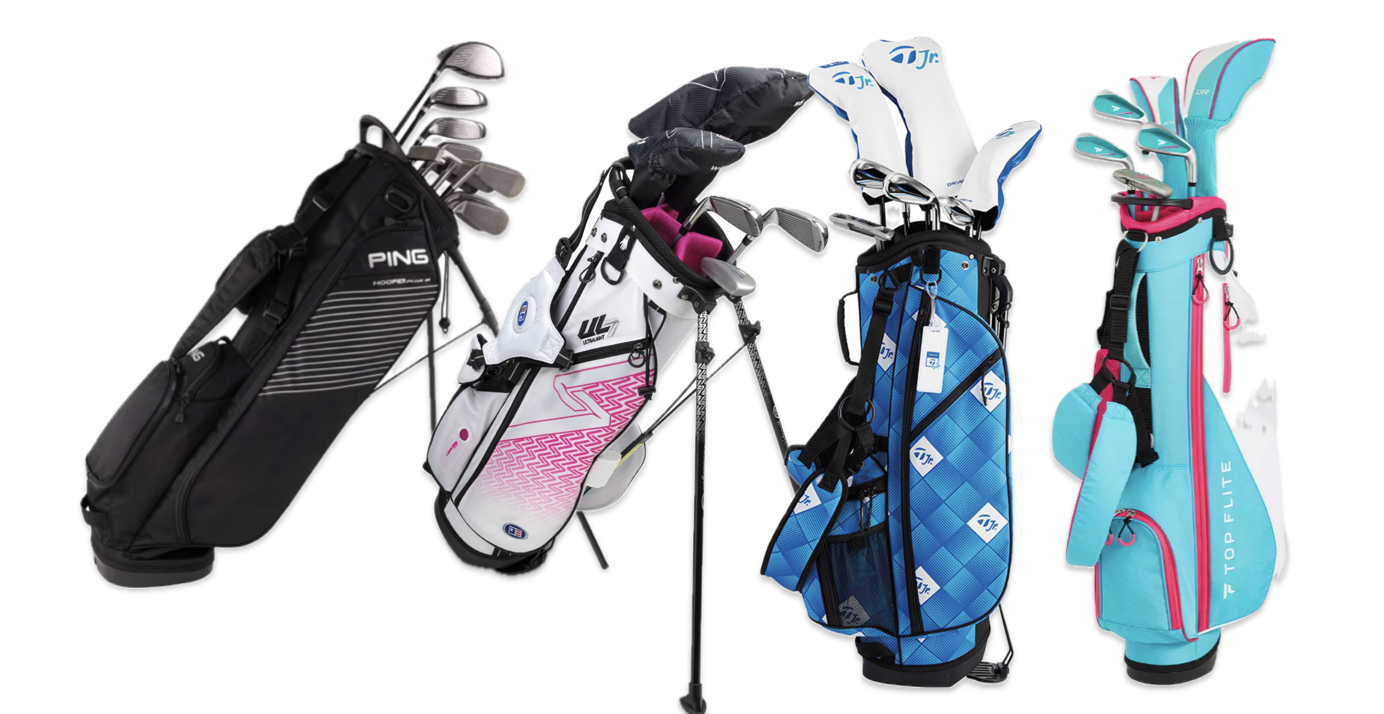
Finding the Right Set for Your Child
You might think junior golf clubs have a limited selection. In reality, the opposite is true! Once you factor in brand, club length, number of clubs, and price, the options can quickly become overwhelming.
So where should you start?
The key is to match your child’s experience level and budget to the right set of clubs. In this guide, we’ll break junior golf clubs into three categories: just learning, the developing golfer, and the competitive golfer. Each category offers different levels of performance, customization, and price.
Before You Buy: Understanding Gapping
One important concept to understand when buying golf clubs is gapping. Gapping is the difference in distance between the clubs in your bag.
For example, if your 7-iron travels 70 yards and your 9-iron travels 60 yards, you have a 10-yard gap between those clubs. That’s generally a useful distance difference for a developing golfer, so in this case, there is no need for an 8-iron.
Junior sets often include fewer clubs than adult sets because younger players don’t necessarily need a club for every possible distance. A younger golfer might do just fine with five clubs, while a competitive junior may eventually benefit from a more complete set of up to 14 clubs.
Rather than simply buying more clubs to fill the bag, focus on the distances your child can comfortably hit and then decide whether additional clubs would provide any benefit. As your junior develops, you can add individual clubs to fill gaps as needed.
1. Just Learning: $200 price point
Best for: Beginners trying golf for the first time or figuring out whether they enjoy the game.
When your child is just starting out, you don’t need to spend a fortune. A set around $200 can be an excellent starting point, providing the essential clubs needed to learn the game without making a big financial commitment.
My recommendation: Top Flite Junior Sets


Top Flite is a practical entry-level option, particularly because its junior sets are available through Dick’s Sporting Goods. You can shop at a familiar retailer rather than hunting for a specialty golf store.
The sets are organized by height, making it easier to find an appropriate starting point. Depending on the size and configuration, you’ll find sets ranging from a few essential clubs to more complete beginner packages.
Here’s the general breakdown of the sets:
- 3-club set: Driver, 7-iron, and putter.
- 5-club set: Adds a hybrid and sand wedge.
- 6-club set: Adds a 9-iron.
** Take a good look at what is included as retailers may count head covers as pieces of the “set”.
Top Flite is a good option for families who want to get their kids on the course without overcomplicating the buying process. However, these are entry-level sets, and you generally won’t have the same ability to customize the bag by purchasing individual matching clubs later.
Want to spend a little more?
Consider the US Kids Golf Ultralight clubs. It offers more sizing options and a path from beginner equipment toward more advanced junior clubs. We’ll cover that range in the next section.
Other brands worth exploring in the entry-level category include Tour Edge, Precise, and Wilson. Compare the actual set contents, sizing, and price to determine which offers the best value for your needs.
2. The Developing Golfer: $300–$700 price point
Best for: Kids who enjoy golf, play regularly, and are ready for equipment that can grow with their skills.
Once your child is committed to golf, it may be worth investing in a better-fitting set. At this stage, you’ll want to consider club performance, sizing, and the flexibility to add individual clubs as your junior improves.
My recommendation: US Kids Golf Ultralight


US Kids Golf is my top recommendation for this category. The clubs are available through retailers such as PGA TOUR Superstore or directly from the manufacturer.
What makes US Kids Golf stand out is its combination of performance, sizing options, and flexibility. You can start with a smaller set and add individual clubs as your child develops, rather than replacing the entire bag every time you want to change its configuration.
A sizing system that makes sense
The thing I like most about US Kids Golf is its height-based sizing system. The clubs are organized into color-coded size groups, making it easier for parents to identify the appropriate starting point.
For example, a child in the 42–45-inch height range would look at the corresponding yellow size category. The range starts with smaller children (36″-39″) and extends into the taller junior sizes (66″-69″). US Kids offers 11 size categories in total.
Instead of choosing clubs based on age alone, start with your child’s height and then confirm the manufacturer’s current sizing recommendations.
What comes in a set?
The default club set configuration varies by heigh category. For example, a smaller Ultralight set may include a driver, 7-iron, pitching wedge, and putter. A larger set may include a driver, hybrid, selected irons, wedges, and a putter.
You can also purchase individual clubs to customize the bag as needed. That flexibility is a major advantage: you can add clubs when your child starts hitting the ball farther or needs more options for different distances.
My kids grew up playing US Kids Golf clubs, from around ages 7 through 10. We started with a set that included a driver, 7-iron, pitching wedge, sand wedge, and putter. We quickly added a hybrid, 8-iron, 6-iron, and fairway wood. My child drove it 140yards, and the gapping didn’t warrant us to have that many clubs, but it was just cool to have!
My advice: Don’t overthink the decision. Start with the appropriate height category, choose a set that fits your budget, and add clubs as your junior’s game develops.
Why not buy competitive clubs right away?
It’s tempting to purchase more advanced equipment because you want your child to have the best possible clubs. But more expensive doesn’t automatically mean better performance for every golfer.
Clubs designed for competitive players may offer different performance characteristics and less help on off-center strikes, depending on the model. Developing golfers often benefit more from equipment that is easy to launch and forgiving when contact isn’t perfect.
The goal isn’t to buy the most advanced clubs available. It’s to buy clubs that help your child play better right now, while leaving room to improve.
Other brands worth comparing in this category include Callaway, Cleveland, and Mizuno. Check their current junior offerings carefully, since the available models, configurations, and sizing options can vary. Prior to the Pings, we played the Callway XJs and were really happy with them. What drove us to US Kids was the expansive set of clubs they offer.
3. The Competitive Golfer: $1,000+ price point
Best for: Juniors who play competitively, practice regularly, and want equipment with more advanced performance and fitting options.
Now we’re stepping up both performance and price.
At this level, you’ll want to look beyond a basic junior set. Club construction, shaft characteristics, club length, lie angle, and the ability to customize the bag become more important. The performance is just below actual adult clubs, but I’d argue that the performance is comparable.
A few brands and product lines worth exploring are PING Prodi G, US Kids Tour Series, and Flynn Golf.
My recommendation: PING Prodi G


My first recommendation in this category is PING Prodi G. These clubs are designed specifically for junior golfers and offer fitting and customization options that can help competitive players find equipment suited to their swings.
My own kids have used PING Prodi G clubs since around age 10, and I’ve appreciated the ability to customize the setup as their games have developed.
Depending on the model and current offering, options can include different club lengths, shaft specifications, and lie angles. You can build a set around your child’s needs, purchase a complete set, or add individual clubs to fill specific distance gaps. Instead of picking a size grouping like US Kids, you can specify the exact length – down to a quarter of an inch, change the lie angle, and choose between a junior regular shaft or junior stiff shaft. Although I appreciate the customizable option, it’s almost overwhelming. However, the BEST DEAL is that they offer a one time shaft replacement. So once your junior outgrows their clubs, you can send it back to Ping and they will do a free 1 time shaft replacement!
PING also offers a junior fitting tool on its website. By entering information such as your child’s height and swing characteristics, you can get guidance on suitable club specifications and set composition.
What about US Kids Golf Tour Series?
US Kids Golf Tour Series is another option to consider for competitive juniors. It provides an alternative to the Ultralight line for players looking for a different level of equipment and performance.
Compare the specific models and fitting recommendations rather than assuming one product family is automatically better for every competitive player.
An alternative: Flynn Golf
If you’re willing to explore a less familiar brand, Flynn Golf offers junior club options with a focus on fitting and customization.
One trade-off is the buying experience. If you purchase directly from a manufacturer rather than through a local retailer, it may be harder to try the clubs in person before buying. Consider how comfortable you are choosing equipment online and whether you can get fitting guidance before making the investment.
Don’t overfit a growing junior
Here’s an important consideration: kids grow quickly.
Although a precise fitting can help, you don’t necessarily need to chase a perfect fit that lasts indefinitely. Your child’s height, strength, and swing can change substantially over a season.
For that reason, I would focus on getting the important specifications right today while considering how easily you can adjust or replace clubs as your child grows. Avoid paying for customization that won’t meaningfully improve your child’s experience.
The bottom line: For a competitive junior, I would start by comparing PING Prodi G and US Kids Golf Tour Series. Consider Flynn Golf as another option if its fitting approach and available configurations suit your needs.